Car Safes: Console, Under-Seat and Portable Vehicle Safes
A car safe is a small steel container made to stay in a car or truck: built into the console, bolted under a seat, or tethered by a cable. The table lists vehicle safes of every mounting type we track. A car is a box with windows. A car safe is the part of it that isn't.
Compare models
In this tableSafes for cars and trucks, including console, under-seat and cable-mounted models. Values we could not confirm show as "—".
We earn a commission if you buy through our links, at no cost to you. Disclosure
No live products match this page yet. The table fills in automatically when listings that fit the rule are available on Amazon US.
A vehicle safe is a small locked box that stays with the car. People use them for a handgun, cash, a passport while travelling, medication, a tablet or a wallet left behind at the gym. This page covers car safes for any of those jobs. If you're buying specifically to store a handgun in a vehicle, our car gun safes page focuses on that.
A vehicle safe is defined by how it attaches
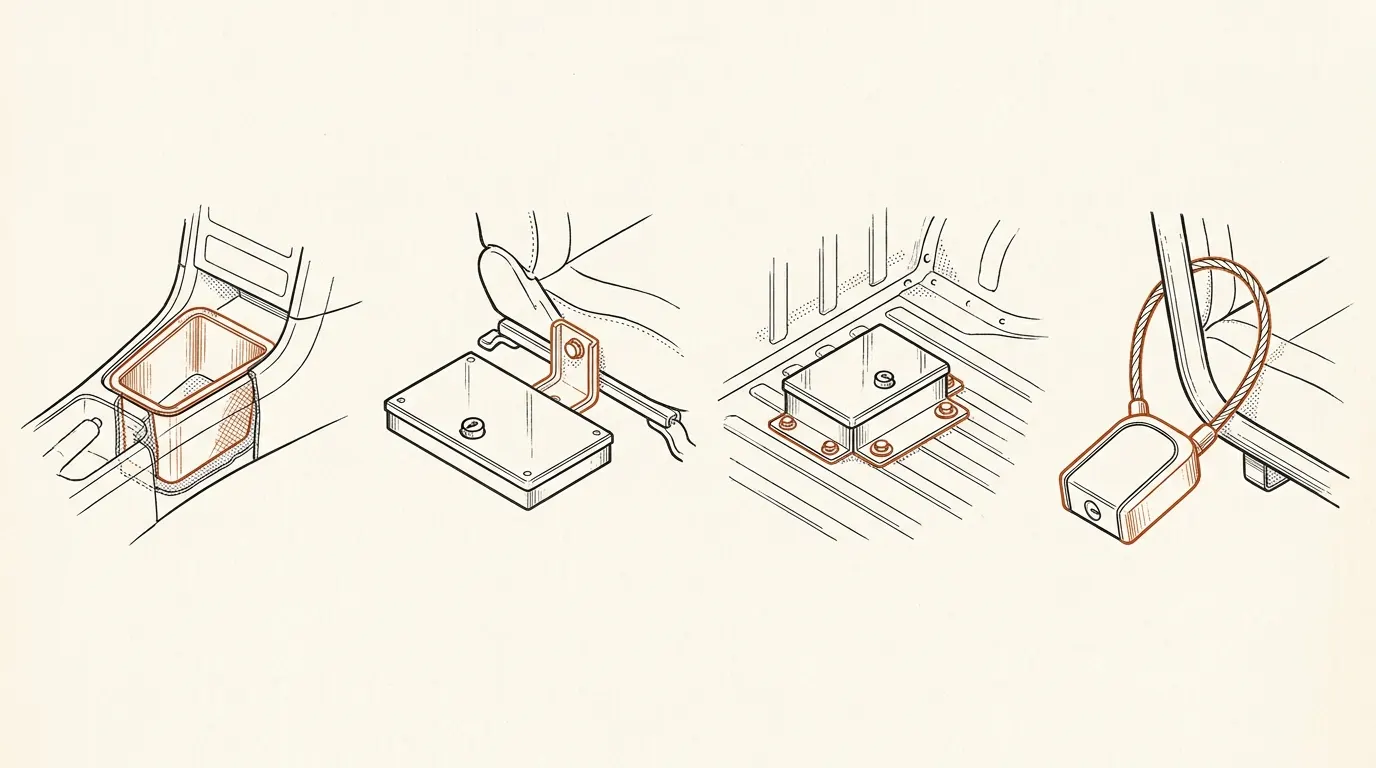
Car safes come in a handful of shapes. What separates them is not the box, which is usually a small steel container with a key, keypad or combination lock. It's how the box is held in the car.
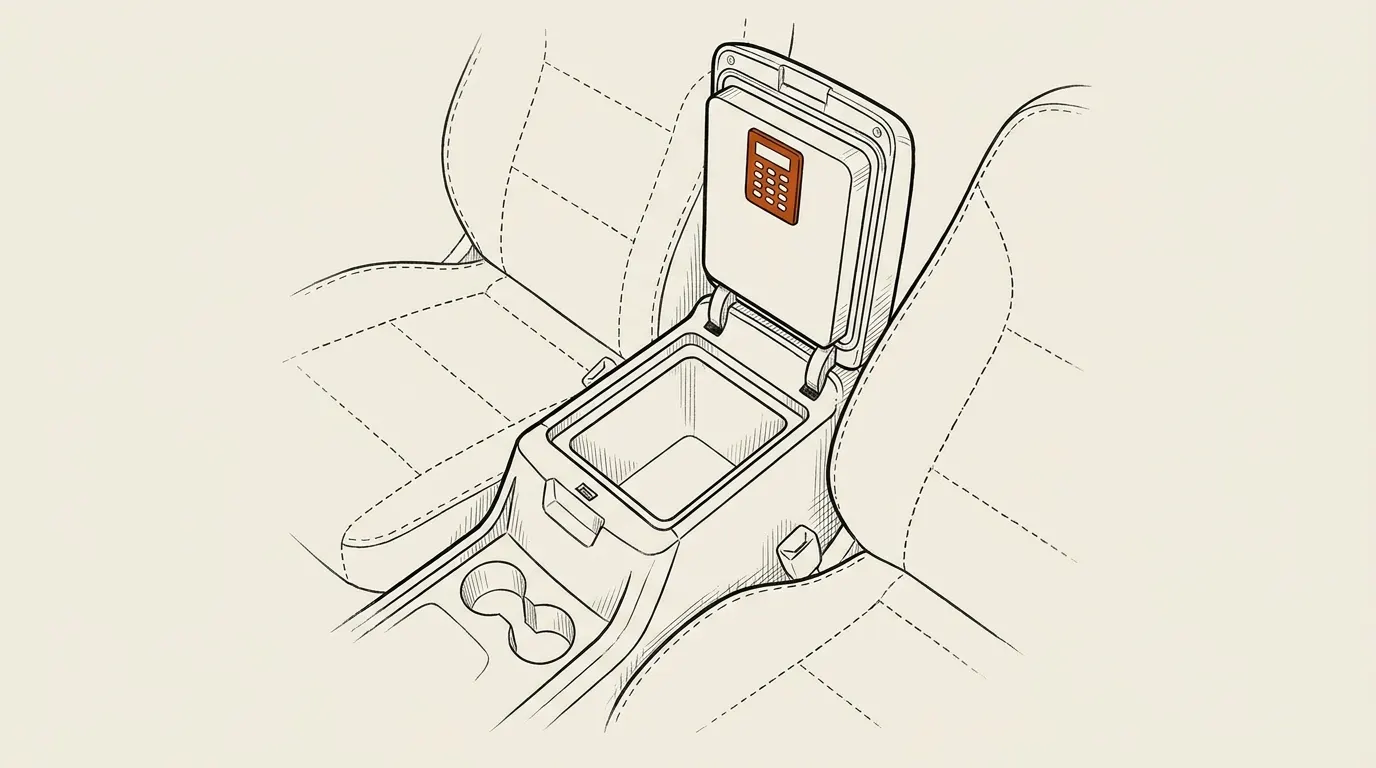
- Car console safes. A steel liner that fits inside the factory center console, made for specific makes, models and years.
- Underseat car safes. A flat box bolted to the floor or seat frame under a seat, or held by a bracket on a seat bolt.
- Lock boxes for a car trunk. A box secured in the trunk or cargo area, usually by bolts or a cable.
- Portable car safes. A small safe with a steel cable that loops around a seat frame or other fixed point. It goes from car to house to hotel room.
A hidden car safe is usually one of the first two: inside the console, or under a seat where it isn't visible through the window. Out of sight helps. Attached helps more.
Who a car safe box suits, and who should skip it
A car safe makes sense if:
- Things regularly stay in the car. A wallet during a workout, documents on a road trip, a handgun where the law allows it.
- You drive one vehicle most of the time. Console and under-seat safes are fitted to one car.
- You want a locked place that isn't the glovebox. Gloveboxes and consoles often lock with a simple key, if at all.
Skip it, or choose differently, if:
- You change vehicles often. A portable car safe with a cable moves with you; a console vault doesn't.
- You need to store something large. A laptop safe for a car exists, but most console and under-seat safes are sized for small items. Check the interior dimensions.
- You want fire protection. Vehicle safes are built for access control and theft resistance. A fire rating is not what this category is designed around.
What to look for in a car safe: mounting first, then the rest
How it attaches. This is the most important line on the listing. Console Vault, for example, says its safes are designed to fit the factory console "without any modification," that "no cutting or drilling is required," and that its safes use factory bolts and hardware. Vaultek's mounts for its portable safes include a strap around the seat, a bracket fitted with a frame-rail bolt, and an included security cable meant to "help deter theft and help prevent common smash and grabs."
A cable and a bolt are different promises. A cable keeps the safe from being lifted out in one move. A bolt makes it part of the car. Picture Kevin, our hypothetical burglar. Kevin's favourite safe is the one he can carry to his car. A car safe that isn't attached saves him the walk.
Vehicle fit. Console safes are made for specific vehicles. Check the maker's vehicle list for your make, model and year before you order.
Steel. For sheet steel, a lower gauge number means thicker steel: under the federal standard gauge, 12-gauge is 0.1094 in and 16-gauge is 0.0625 in. Where the listing gives the gauge, the table shows it.
The lock. Keypad, combination, key or fingerprint. In a car, think about gloves, cold, and opening it without looking. Ask where the backup key lives, and keep it out of the car.
Ratings. Check whether the listing names a burglary rating at all, and who issued it. Under UL 1037, lighter or portable security containers may also be drop-tested onto concrete, so a car safe that does carry an RSC listing has been through that too.
Interior size. Measure what you plan to store, including a laptop, a tablet or a handgun in its holster.
Where you can reach it. A console safe opens from the driver's seat. An under-seat safe usually means leaning over or opening a rear door. A lock box in the trunk is only reachable once you've parked and walked around the car. Decide which matters more for what you store: being reachable from the seat, or being out of the way.
Vehicle safes for trucks, SUVs and vans
The phrase "vehicle safe" usually covers more than cars. Pickups, SUVs and vans have different spaces, and the same four mounting types adapt to them.
- Trucks. Under-seat and rear-seat-area safes are common, since many cabs have room behind or below the seats. Console safes are made for specific truck models too.
- SUVs and wagons. A box secured in the cargo area works like a trunk lock box, but the cargo area is often visible through the rear glass. A cover helps.
- Vans and RVs. Fit varies most here. Console Vault, for example, says it has no RV-specific models, so check what a maker supports before assuming a fit.
Storing a handgun in a vehicle safe: plain facts
Many vehicle safes are sold for handguns. Laws on carrying and storing firearms in vehicles differ by state, and nothing on this page is legal advice. Check your state's official source; California's Department of Justice, for example, publishes its firearm rules on oag.ca.gov.
A Department of Justice handout from the U.S. Attorney's Office for the District of Vermont advises storing firearms locked and keeping keys and combinations out of children's reach. That applies in a car as much as at home. A vehicle safe reduces access only when it is closed and locked.
Heat is a factor too. SAAMI, the ammunition makers' standards body, advises against leaving ammunition in a closed car in the sun. For handgun-specific vehicle safes, see car gun safes and portable gun safes.
How to read the table and choose a car safe
The table lists vehicle safes, including console, under-seat and cable-mounted models. A dash means a value is not confirmed.
- Read the mounting first. Console, under-seat, cable or bolt-down. Match it to your vehicle and how long you'll keep it.
- Then interior size. Compare it with the largest item you'll store.
- Then steel and lock. Gauge where stated, lock type, and the backup.
- Then check fit. For console safes, confirm your exact vehicle on the maker's list.
If you'll move the safe between vehicles or into a hotel room, favour a portable car safe with a cable. If it will stay in one truck for years, a console or bolt-down mount is the stronger option. For a small box that doesn't need to live in the car at all, see lock boxes.
Installation is vehicle-specific. Vaultek's own advice, as a safety precaution, is to consult a certified automotive technician before installing its mounts. Our guide to gun safe installation covers vehicle installs in more detail.
Brands that make car and vehicle safes
The brands below have vehicle safes in this table. Each brand page lists its models with mounting, steel and lock details where confirmed.
Decide where in the car the safe will live and how it will attach, then measure what goes inside. Shortlist the safes in the table that fit both, confirm your vehicle on the maker's list, and check the price. Then take the backup key out of the glovebox.
Related pages
Questions people ask about car safes
What is a vehicle safe?
A vehicle safe is a lockable steel container designed to be secured inside a car or truck, for example in the center console, under a seat or in the trunk. It is secured by bolts, brackets or a steel cable so it cannot simply be lifted out.
Do console safes require drilling?
It depends on the product. Console Vault, for example, says its safes fit the factory console of specific vehicles, use factory bolts and hardware, and require no cutting or drilling. Other makers' mounting methods differ, so check the manual.
Is a cable enough to secure a portable car safe?
A cable deters a quick grab and keeps the safe from being lifted out in one move. Vaultek, for example, says its included security cable is meant to help deter theft and smash-and-grabs. A safe bolted to the vehicle is harder to remove than one tethered by a cable.
Can I keep a laptop in a car safe?
Only if the interior is large enough. Most console and under-seat safes are sized for small items. Check the interior dimensions against your laptop before you buy.
Can I store a handgun in a car safe?
Many vehicle safes are sold for handguns. Laws on carrying and storing firearms in vehicles differ by state. Check your state's official guidance; this page is not legal advice.
Sources
- Frequently Asked Questions (Console Vault) — accessed 2026-10-12
- Support: Vaultek Accessories (Vaultek) — accessed 2026-10-12
- Intertek requirement-change notice: UL 1037 revision 9-9-2016, Section 54 Residential Security Containers — accessed 2026-10-12
- 15 U.S. Code sec. 206 - Standard gauge for sheet and plate iron and steel (Cornell LII) — accessed 2026-10-12
- Small Arms Ammunition: Properties & Recommendations for Storage & Handling (SAAMI Item 202) — accessed 2026-10-12
- Safe Storage of Firearms: Unload it, Lock it, Store it (U.S. Attorney's Office, District of Vermont) — accessed 2026-10-12
- Bureau of Firearms (California Department of Justice) — accessed 2026-10-12