Closet Safe Guide: Size, Fire Rating and How to Anchor It
A closet safe is a home safe sized to sit on a closet floor, typically 1 to 4 cubic feet inside, usually fire-rated, ideally bolted down. The closet is where most home safes end up, because it's out of sight and close at hand. It's also the first room a burglar checks, so the anchor matters more than the hiding place.
Compare models
In this tableHome safes from 1 to 4 cu ft — sizes that typically fit a closet floor. Values we could not confirm show as "—".
We earn a commission if you buy through our links, at no cost to you. Disclosure
No live products match this page yet. The table fills in automatically when listings that fit the rule are available on Amazon US.
This page covers home safes sized for a closet floor. For gun safes and cabinets that fit a closet, see closet gun safes. For home safes in general, start at our home safes hub.
A closet safe is a home safe sized for the floor of a closet
There's no standard that defines a closet safe. In practice it means a home safe big enough to hold documents, cash, jewelry and a few hard drives, and small enough to fit under hanging clothes. Our table uses a simple rule: home and fire safes from 1 to 4 cu ft inside.
That size range covers most of what people buy for a bedroom closet:
- Around 1 cu ft. A compact safe for passports, a few envelopes and some jewelry. Fits on a closet shelf or the floor in a corner.
- Around 2 cu ft. Room for document folders standing up, a small box of valuables and a drive or two.
- Around 3 to 4 cu ft. A tall or wide safe that takes up a real slice of the closet, with shelves and a door pocket.
Below 1 cu ft, see our small safes. Above 4, see large safes.
Who a closet safe suits, and who should skip it
It suits you if:
- you keep paper originals, cash or jewelry at home and want them in one locked place
- you have a closet floor you can anchor to
- you want the safe out of view of visitors and windows
- you need fire protection for documents in a bedroom or hallway closet
Skip it, or look elsewhere, if:
- you're storing firearms; see closet gun safes for gun-specific sizes and ratings
- you can't anchor to the floor; a closet safe that isn't fixed down is a carry-out
- your closet floor can't take the weight, or the stairs and doorways can't take the route in
- you want the safe hidden rather than anchored; our hidden safe ideas guide covers when hiding helps
Closet safe ratings: what to look for
The closet is the problem this section solves. Everybody puts the safe there, so everybody looks there first. Picture Kevin, our hypothetical burglar: he heads for the main bedroom closet, finds the safe behind the coats, and checks whether it moves. That check is what the specs below are for.
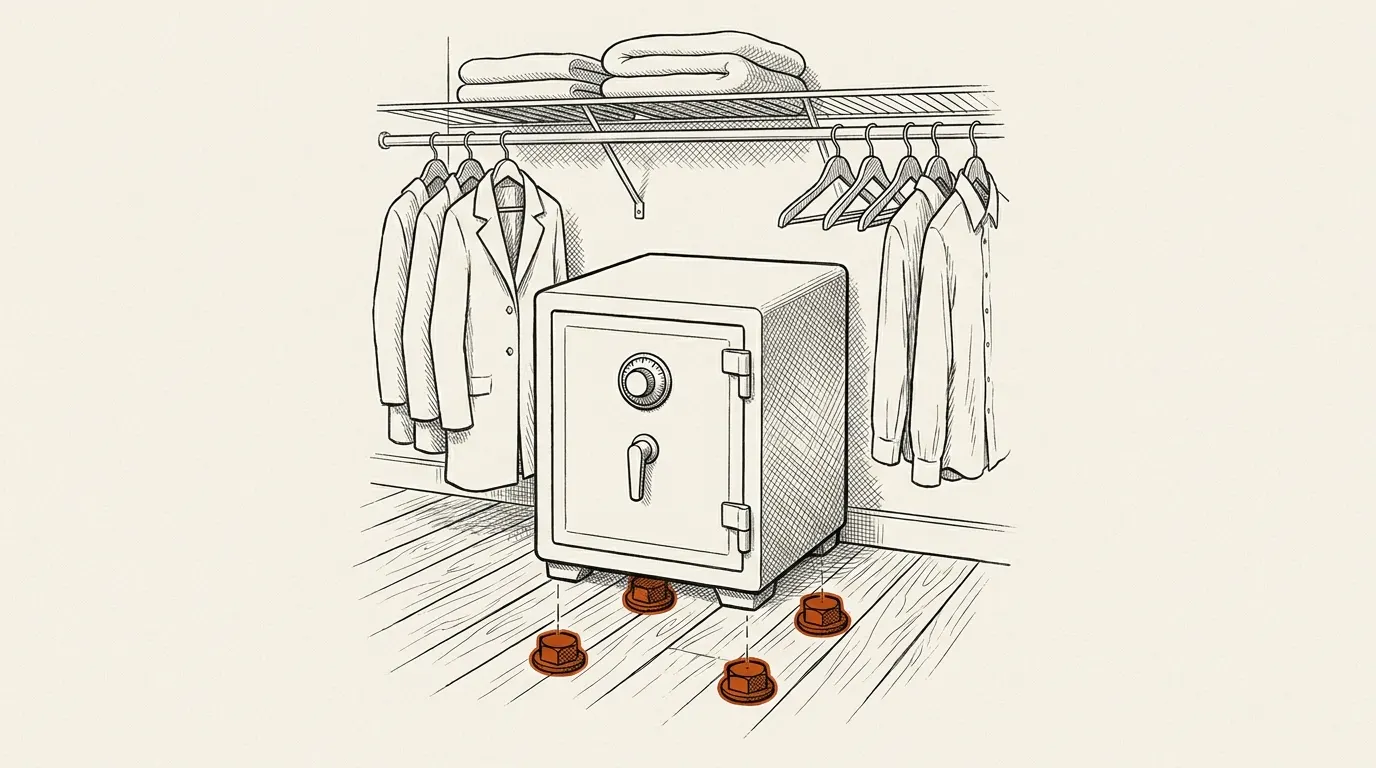
Anchoring. Pre-drilled holes in the floor of the safe and included anchor hardware. This is the first spec on a closet safe, not the last. Many closet-size safes weigh little enough for one or two people to carry. Bolted to a slab or a joist, they're a much bigger job.
Fire rating. A closet safe fireproof claim should come with three parts: duration, temperature and who tested it. UL describes its fire rating as a class, the maximum interior temperature reached during testing, and a time rating, for example ½, 1 or 2 hours. UL 72 Class 350 is intended for paper records. Class 125 is the strictest, intended to also protect sensitive media. A rating tested by the manufacturer is a claim; a UL listing is a rating. Our fire-rated home safes page goes into detail.
Burglary rating. UL says a fire label says nothing about burglary, and the reverse holds too. A UL 1037 Residential Security Container (RSC) Level I rating means the container resisted a 5-minute attack by one person with common hand tools and a small electric drill. Most closet safes carry no burglary rating, which is why the anchor matters.
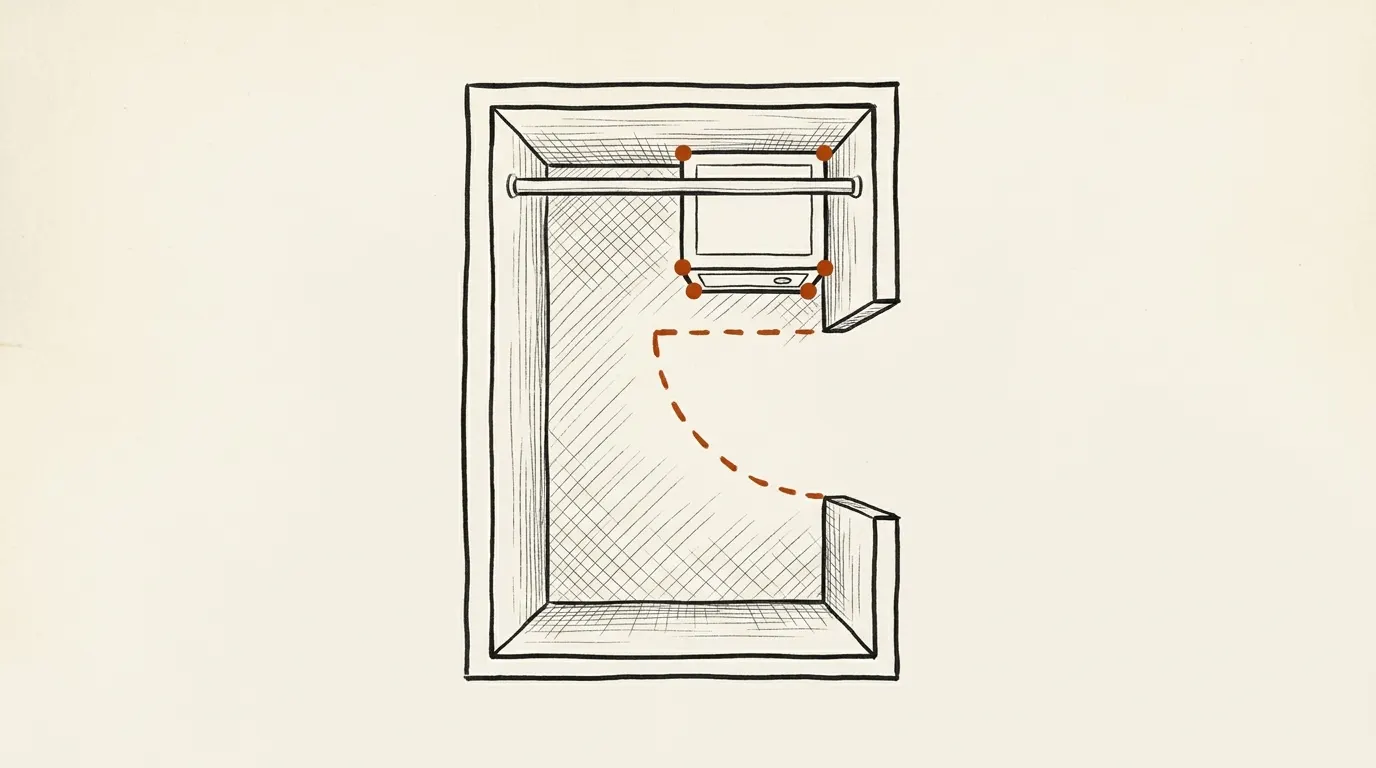
Exterior dimensions and door swing. Closets are narrow. Check the exterior depth including the handle and keypad, and leave room for the door to open fully. A door that only opens halfway is a shelf you can't use.
Interior layout. Shelves, door pockets, a drawer, a key rack. Hanging file rails if you keep folders. Compare interior dimensions with the folders and boxes you'll actually store.
Lock. Keypad, fingerprint, dial or key. In a dark closet, a lit keypad helps. Check where the battery lives and where the backup key will go.
Closet safe, closet gun safe or wall safe: which one fits the job
Three types compete for the same closet. They solve different problems.
- Closet safe. A freestanding home safe for documents, cash and jewelry, usually fire-rated, bolted to the floor. The most flexible choice, and the one this page covers.
- Closet gun safe. Taller and deeper, built for long guns, and often heavier. Our closet gun safes page lists gun safes and cabinets no taller than 60 in and no deeper than 22 in.
- Wall safe. Mounted between studs, behind clothes or a panel. Easy to conceal, limited in depth by the wall cavity. Check the listing for a fire rating; many don't state one. See our wall safes page.
If the closet is the only place for everything, a gun safe with a fire rating may cover both guns and documents. If guns are stored elsewhere, a closet safe is smaller, lighter and easier to anchor. A wall safe makes sense as a second, concealed spot for small items, not as the main fire protection for documents.
How to install a safe in a closet
Manufacturers publish installation steps, and they're worth following exactly. Liberty Safe's closet installation advice, for example, says to measure the safe, the installation area and the entire path in, and to check that an upper-floor closet's joists can carry the load. The general order:
- Measure first. Closet floor depth and width, the closet door opening, every doorway and turn on the route in, and the safe door's swing.
- Check the floor. Concrete slab or wood subfloor over joists. The anchoring method differs.
- Check what's under it. Pipes, wires, radiant heat, and on slabs, post-tension cables. Our floor bolting guide explains the warnings.
- Place and mark. Set the safe where the door opens fully, then mark the anchor holes through the safe floor.
- Drill and anchor. Use the anchors the manufacturer specifies for your floor type. On carpet, the anchors go into the subfloor below, not the padding.
- Test. Lock it, try to rock it, then load it.
If you rent, ask the landlord before drilling. A safe that can't be anchored still protects against fire and casual access, but not against being carried out.
How to read the closet safe table: footprint, fire, then volume
The table lists home and fire safes with an interior of 1 to 4 cu ft. Values we couldn't confirm show as "—."
- Filter by exterior size. Start from your closet's measurements.
- Read the fire columns together. Duration, temperature and who tested it. A small closet safe fireproof listing with no tester is a manufacturer claim.
- Check weight. Heavier is harder to carry off and harder to get upstairs.
- Check the lock and backup columns. Electronic locks need batteries and a backup key.
- Compare interior volume last. It's the easiest number to compare and the least useful on its own.
When two safes look alike, pick the one with a stated fire rating from a named lab, anchor hardware in the box, and a door that opens fully in your closet.
Measure the closet, then anchor the safe
Measure the closet and the route in before you choose. Pick a fire rating that matches what goes inside. Then bolt it down, and keep the backup key out of the closet.
Related pages
Questions people ask about closet safes
How do you install a safe in a closet?
Measure the closet floor, the door opening and the route in. Place the safe where the door can open fully, mark the anchor holes, and bolt it to the floor using the hardware and method the manufacturer specifies for concrete or wood. Check for pipes, wires and radiant heating before drilling.
What size safe fits in a closet?
Measure the closet's depth, width and door opening, and leave room for the safe door to swing open. Compare those numbers with the safe's exterior dimensions, not its interior volume. Allow extra depth if the safe has an external handle or keypad.
Should a closet safe be fire-rated?
If it will hold documents, yes. Look for a fire rating that states the duration, the interior temperature class or test temperature, and who tested it. UL 72 Class 350 ratings are intended for paper records.
Does a closet safe need to be bolted down?
Yes, in almost every case. Many closet-size safes are light enough for one or two people to carry. Anchoring to the floor makes removal much harder. Follow the manufacturer's instructions, and ask your landlord first if you rent.
Is a closet the best place for a safe?
It is the most common place, which is both its strength and its weakness. A closet is convenient and keeps the safe out of view, but burglars know it. A closet safe should rely on being anchored and locked, not on being hidden.
Sources
- Turning Up the Heat: A Sneak Peek into UL's Fire Testing of Safes (UL) — accessed 2026-10-12
- UL 72 Tests for Fire Resistance of Record Protection Equipment (UL Standards & Engagement) — accessed 2026-10-12
- Anti-Theft Device Testing and Certification (UL Solutions) — accessed 2026-10-12
- Intertek requirement-change notice: UL 1037 revision 9-9-2016, Section 54 Residential Security Containers — accessed 2026-10-12
- UCR Summary of Reported Crimes in the Nation, 2025 (FBI) — accessed 2026-10-12
- Smart Safe Installation: Maximizing Space in Your Closet and Garage (Liberty Safe) — accessed 2026-10-12