Humidity for a Gun Safe: What Number to Aim For
Ask five sources for the ideal humidity in a gun safe and you get four numbers. Same steel, same walnut, same physics. The numbers are closer than they look, and the reason they differ is the useful part. The short version fits on a sticky note. Unlike the safe code, this one can stay there.
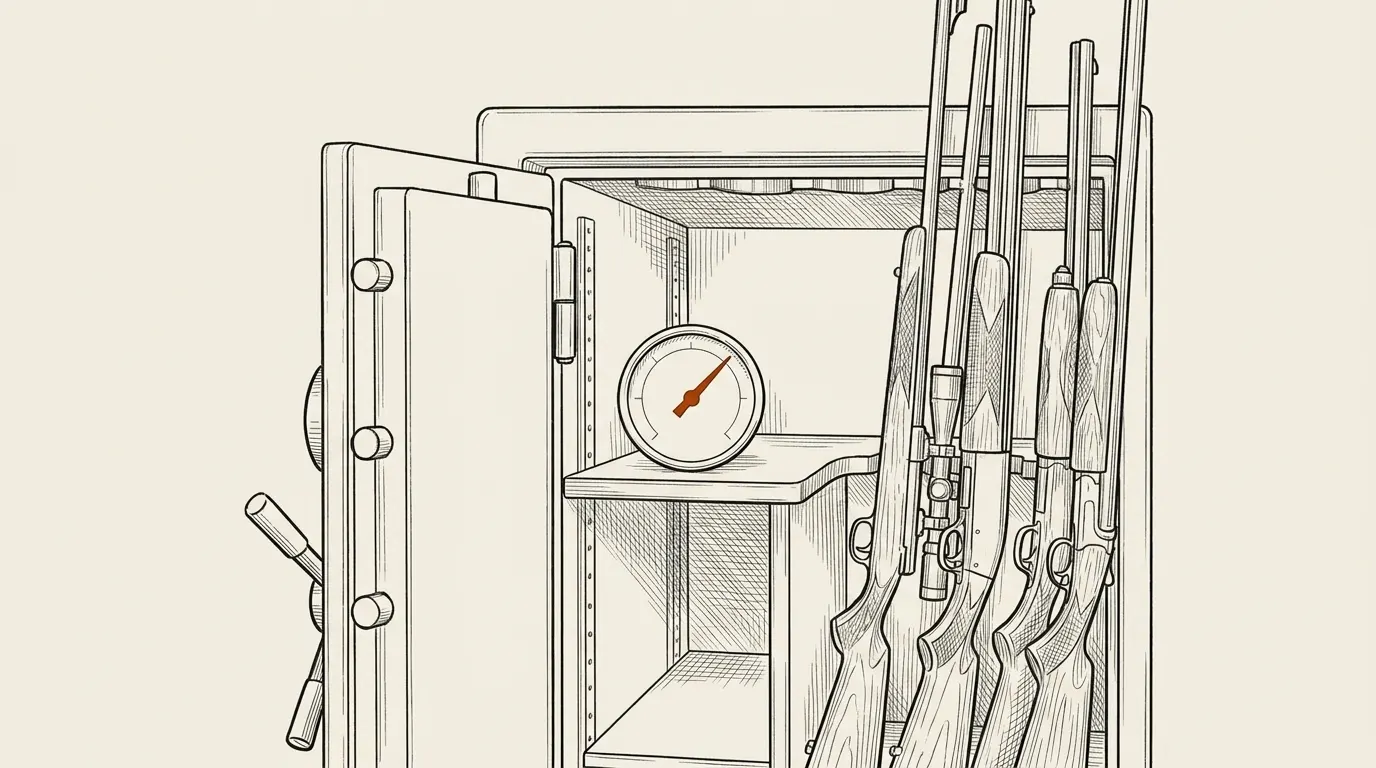
Short answer: The ideal humidity for a gun safe is a steady 40–50% relative humidity, at a stable room temperature. That's where Liberty Safe's two published ranges overlap, and it sits inside the EPA's ideal range for a home. Below about 35% is good for bare steel and risky for wooden stocks. At 60% or above, you're over every range we found.
This page is about the target: what number the humidity for a gun safe should read, and why. How to get there — rods, desiccants, recharging — has its own page, our gun safe humidity control guide. If you're still choosing the box itself, start with our gun safes page. Here, we read the hygrometer and decide what the number means.
Gun safe humidity levels: what the sources actually say
There is no UL standard for humidity in a gun safe. Nobody certifies it. So the numbers come from two places: safe makers and the people who look after museum collections. They mostly agree, with different emphasis.
Here's what we found, in the sources' own terms:
- Liberty Safe, moisture guide: cites the NRA as recommending 30–50% humidity in a vault room or gun safe, at around 60–70°F if possible. For a safe holding guns and documents, Liberty says it would "err on the side closer to 30%."
- Liberty Safe, rust guide: "the ideal Relative Humidity (RH) level inside a gun safe should be between 40% and 50%" — dry enough to prevent rust, wet enough to keep wood from drying out.
- US EPA, for homes in general: keep indoor humidity below 60%, "ideally between 30 and 50 percent."
- National Park Service, for metal objects: house them below 35% RH to slow deterioration.
- Canadian Conservation Institute (CCI): for metals, "the lower the RH the better," and above 75% RH all corrosion speeds up a lot.
Same manufacturer, two ranges. The case gets interesting.
The overlap is the answer. 40–50% sits inside Liberty's NRA-cited range, inside Liberty's own rust-guide range and inside the EPA's ideal band for a house. It's the number that doesn't argue with anybody.
Safe humidity for guns is a compromise, because a gun is two materials
The disagreement isn't sloppiness. It comes from what's in the safe. A rifle is steel and wood, sometimes plastic, sometimes bone or ivory. Each wants something different.
The National Park Service says this directly. Its Conserve O Gram on caring for longarms calls firearms "composite objects" made of wood, metal and sometimes high-impact plastics, and notes that each material reacts differently to temperature and humidity. Its advice is to keep RH constant and to pick the level with a conservator.
Steel wants dry air. NPS guidance for metal objects is below 35% RH. CCI agrees on direction: for metals, lower is better.
Wood wants moderate, steady air. Liberty Safe warns that too-dry air can make wood, laminate, ivory and bone stocks "shrink, crack, and warp." And the NPS microclimate guide that recommends very dry storage for metal says not to use it for composite objects that include wood.
So the target for a gun safe is not the driest air you can buy. It's the driest air the stocks will tolerate. That's the job 40–50% does.
Where to look next
Is 60 humidity in a gun safe too high? Yes, and here's the margin
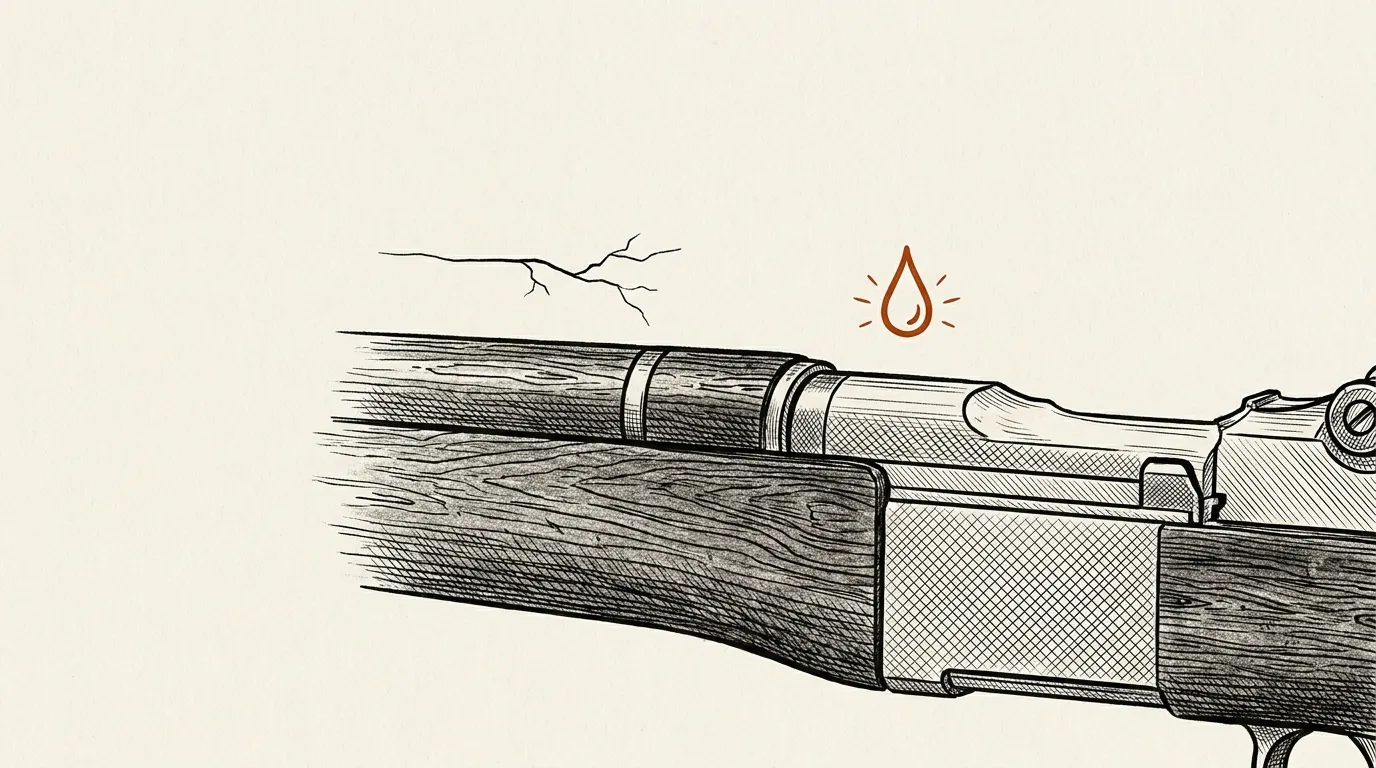
A hygrometer reading of 60% is a common question, and the honest answer is that it's too high. It's above both Liberty ranges. It's at the EPA's ceiling for a whole house. And CCI says mould is "just possible on some surfaces" at 60% RH.
The good news is that rust doesn't flip on like a switch at 61%. CCI describes 75% RH as the practical boundary for "damp," where corrosion of metals speeds up a lot. CCI also notes that ordinary salt (sodium chloride) on metal absorbs water above exactly 75% RH and forms a very corrosive solution.
So read it this way:
- Under 50%: inside the recommended range.
- 50–60%: drifting. Find out why before it settles there.
- 60% and up: act. Our humidity control guide covers the fixes.
- 75% and up: CCI's damp zone, where corrosion speeds up a lot.
A gun safe at 60% isn't an emergency. It's a warning light, and the paperwork has started.

Low humidity in a gun safe: how dry is too dry
Overshooting is real. A strong dehumidifier in a small, tight safe can pull the air well below the range. If the safe holds only stainless steel and polymer, that's no problem. If it holds your grandfather's walnut-stocked shotgun, it is.
Here's how I'd read a low number:
- 35–40%: fine for most collections. Liberty's NRA-cited range goes down to 30%.
- Below 35%: good for bare metal, per NPS. Check wooden stocks for checking or gaps at the inlay.
- Below 30%: under every gun-safe range we found. If you have wood in there, back off the dehumidifier.
There's a second reason to avoid big drops: the swings themselves. CCI's tables show that a ±5% RH fluctuation causes at most "none-to-small" damage even to highly sensitive objects, while ±10% to ±20% can do much more to them. A safe that sits at 45% all year beats one that bounces between 25% and 55%.
(The phrase "keep it as dry as possible" appears on a lot of dehumidifier boxes. The phrase "your walnut stock" does not.)
Gun safe temperature: steady beats specific
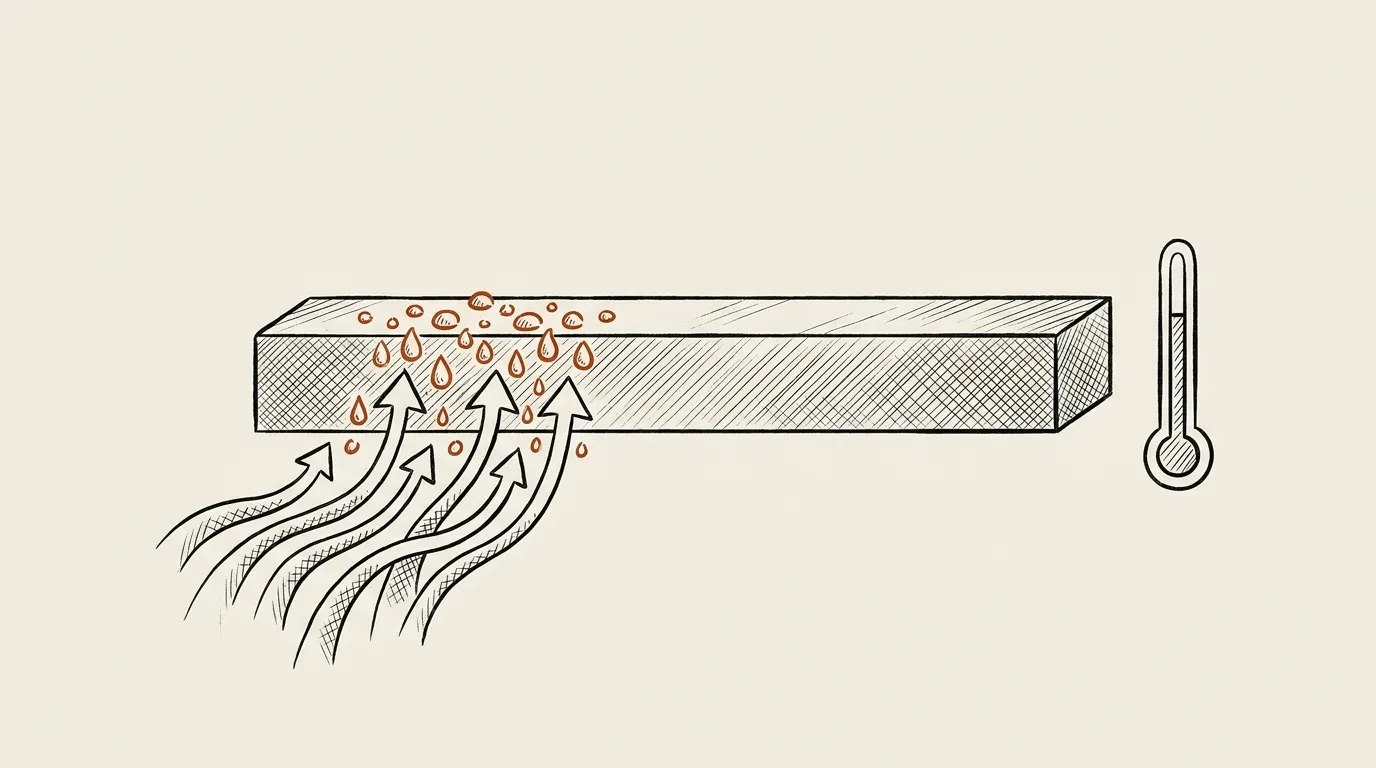
Temperature and humidity are joined at the hip. Relative humidity is relative to temperature: the same amount of moisture in cooler air reads as a higher RH. That's why a safe that reads 45% on a warm afternoon can read higher on a cold night without any new water getting in.
For a target, Liberty Safe cites the NRA's recommendation of around 60–70°F where possible. The NPS longarm guidance gives 64–68°F, though it says that range is "for human comfort" — the people working in the room, not the guns.
What matters more than the exact figure is stability. Liberty's rust guide says temperature fluctuations cause condensation to form on the cool metal surfaces of guns, and that drastic day-to-night shifts do it even in dry climates. Steel takes longer to warm up than air. When warm, humid air reaches cold steel, water lands on the steel.
The ideal gun safe temperature, then, is whatever your living space holds all year, without big daily swings.
Gun safe basement humidity: where the number starts
A closet is the usual home for a gun safe. The basement is the second. They start from different places.
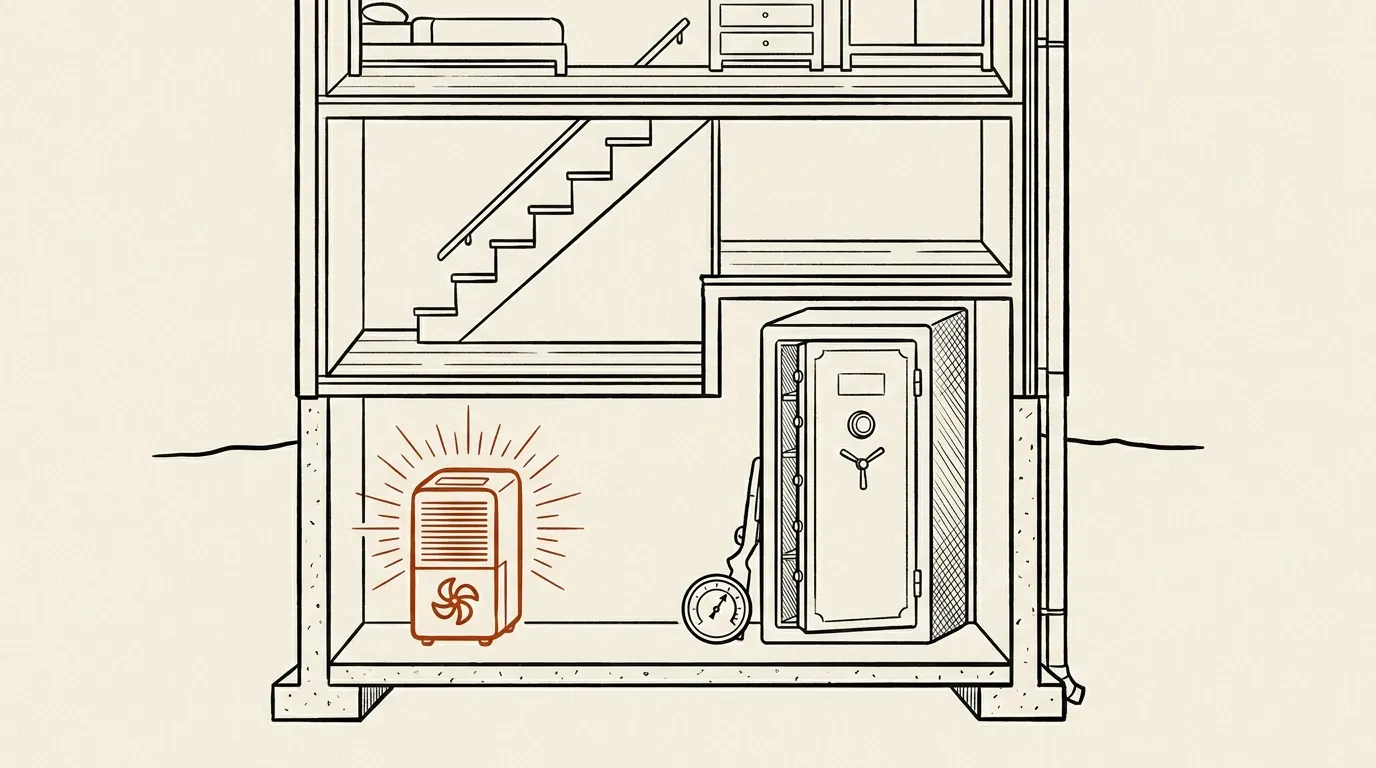
A safe shares the room's air. Liberty Safe says gun safes aren't airtight by design, so humid room air seeps in past the door. If the room sits at 65%, the safe is fighting 65% around the clock. If the room sits at 45%, the safe starts in range.
Basements tend to run cooler than the floors above. Cooler air reads higher RH for the same moisture, and cool walls and floors are where condensation forms. The EPA's mold guide advises using air conditioners or dehumidifiers when needed and keeping indoor humidity below 60%. That's the room's job, and it makes the safe's job easier.
Before you install a safe in a basement, put a hygrometer on the spot where it will stand and leave it there for a couple of weeks. That reading is the starting line. Our guide on where to put a gun safe covers the rest of the placement question.
Measuring humidity in a gun safe without fooling yourself
None of the numbers above mean anything without a measurement. Liberty's rust guide recommends a hygrometer on a shelf where you can easily see it, checked regularly. Three things make that reading trustworthy:
- Calibrate it. The NPS says hygrometer sensors "have a tendency to drift" and recommends calibrating at least quarterly, preferably monthly. A cheap one that's off by 10 points can make you dry the safe when it's fine.
- Give it time. After you open the door, the safe fills with room air. Read it after it has been shut a while, not the moment you close it.
- Watch the trend. A single reading is a snapshot. A week of readings is evidence.
If you store ammunition in the same safe, the same range works for it. Our guide on how to store ammo covers the details.
Here's the catch: the right number depends on what's inside
The 40–50% figure is a compromise for a mixed safe: steel, wood and some paper. Change the contents and the best number moves.
- All steel, polymer and stainless, no wood: you can sit at the lower end, or below. NPS's below-35% guidance for metal applies more cleanly.
- Valuable wooden stocks, older guns, ivory or bone: stay in the 40–50% band and keep it steady. Liberty warns these materials crack in air that's too dry.
- Documents in the safe too: Liberty notes that paper records also suffer when they dry out, and its moisture guide still leans toward the low end for a mixed safe.
- Collector-grade antiques: the NPS advice is to choose the RH with a conservator. That's a person to call, not a number to copy.
And one more catch. A safe's interior isn't uniform. Liberty recommends mounting its dehumidifier rod at the bottom of the safe, and warm air rises. A hygrometer on the top shelf and one near the floor may not agree. If they don't, believe the one nearer your guns.
Skip it if: when you don't need to chase the number
- Your hygrometer already reads 40–50% month after month. You're done. Keep checking and leave it alone.
- You don't own a hygrometer yet. Buy that first. Every number on this page assumes you have one.
- Your collection is all stainless and synthetic. The wood-protection reasoning doesn't apply. Below 50% and steady is plenty.
- You're chasing a single decimal point. CCI's own guidance is that ±5% swings do little harm. A safe at 47% doesn't need fixing.
Put a calibrated hygrometer in the safe and leave the door shut for a week. If it reads 40–50%, write the date on the box and check it again next season. If it reads 60% or above, go to the control guide and pick the fix that matches how your safe breathes.
Save this guide for later
Questions people ask about humidity for gun safes
What humidity should a gun safe be?
Aim for a steady 40 to 50 percent relative humidity. Liberty Safe recommends 40 to 50 percent in one guide and cites the NRA's 30 to 50 percent in another; 40 to 50 percent sits inside both and protects wooden stocks from drying out.
Is 60 humidity too high for a gun safe?
Yes. 60 percent is above every gun-safe range we found, and the EPA advises keeping indoor humidity below 60 percent. The Canadian Conservation Institute notes that mould is just possible on some surfaces at 60 percent.
Can humidity in a gun safe be too low?
Yes, if the safe holds wood. Liberty Safe warns that wood, laminate, ivory and bone stocks can shrink, crack and warp in air that is too dry. The National Park Service recommends below 35 percent for metal objects, but specifically not for composite objects that include wood.
What is the ideal temperature for a gun safe?
Liberty Safe cites the NRA's recommendation of about 60 to 70°F where possible. A steady temperature matters more than a precise one, because swings cause condensation on cool metal.
How often should I check the humidity in my gun safe?
Read the hygrometer regularly, and a week after any change such as a new dehumidifier or a new season. The National Park Service recommends calibrating hygrometers at least quarterly, preferably monthly, because their sensors drift.
Sources
- How to Keep Moisture Out of Your Gun Safe | Liberty Safe — accessed 2026-10-12
- Protect Your Investment: A Complete Guide to Preventing Firearm Rust and Humidity Damage | Liberty Safe — accessed 2026-10-12
- Dehumidifier Rod | Liberty Safe — accessed 2026-10-12
- Agent of Deterioration: Incorrect Relative Humidity | Canadian Conservation Institute — accessed 2026-10-12
- Conserve O Gram 4/16: Creating a Microclimate Box for Metal Storage | National Park Service — accessed 2026-10-12
- Conserve O Gram 10/1: Caring for Historic Longarms: Storage and Handling Requirements | National Park Service — accessed 2026-10-12
- Conserve O Gram 3/2: Calibration of Hygrometers and Hygrothermographs | National Park Service — accessed 2026-10-12
- A Brief Guide to Mold, Moisture and Your Home | US EPA — accessed 2026-10-12