Jewelry Safe Guide: Drawers, Linings and the Ratings That Matter
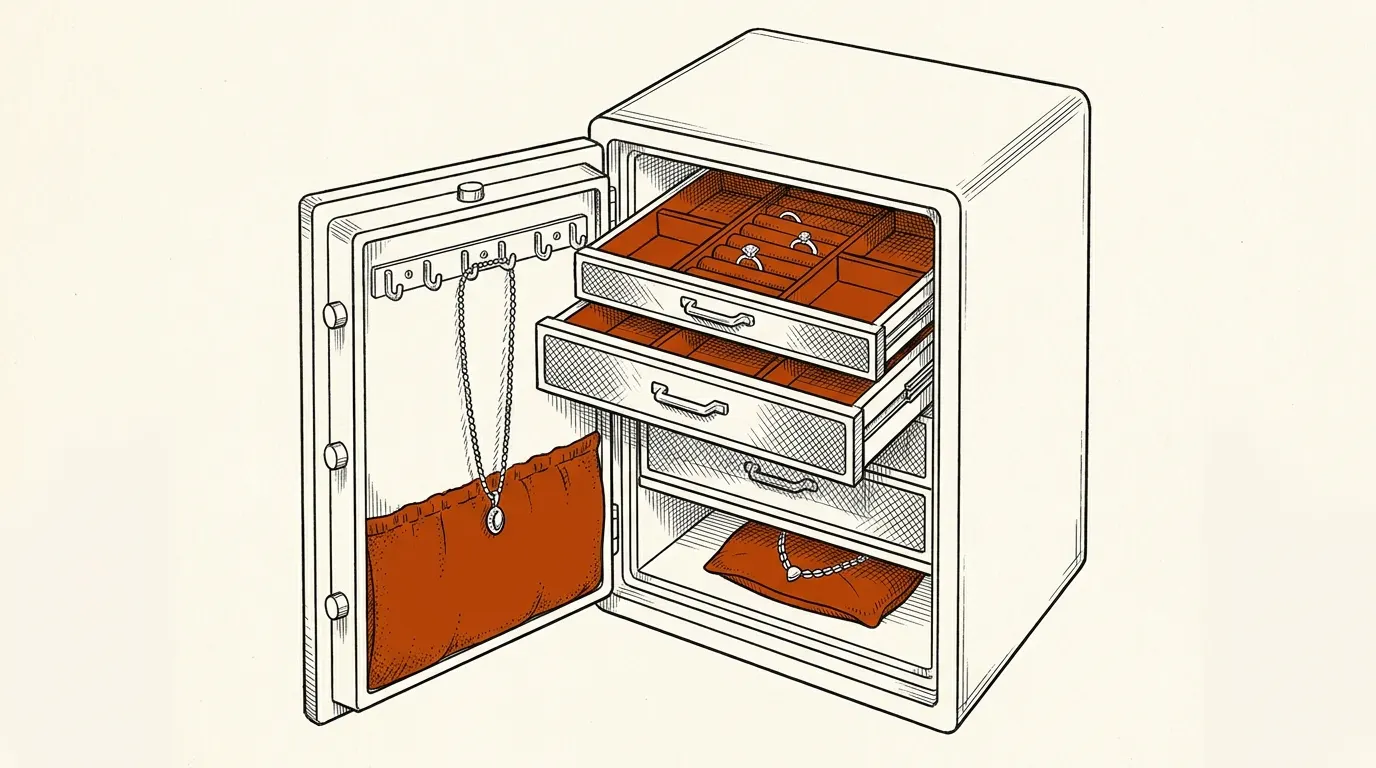
A jewelry safe is a home safe with an interior built for small, valuable things: felt-lined drawers, ring rolls, necklace hooks and trays. The lining protects the jewelry from scratches. The steel, the lock and the anchor bolts protect it from everything else. Listings tend to spend more words on the velvet.
Compare models
In this tableSafes with jewelry drawers or a lined interior. Values we could not confirm show as "—".
We earn a commission if you buy through our links, at no cost to you. Disclosure
No live products match this page yet. The table fills in automatically when listings that fit the rule are available on Amazon US.
This page covers the jewelry safe as a type: what separates it from a home safe, which ratings matter, and how to read the table. For home safes in general, start at our home safes hub.
A jewelry safe is a home safe with a fitted interior
The difference between a jewelry safe and any other home safe is inside. Instead of one open shelf, you get some combination of:
- shallow pull-out drawers lined with felt or velvet
- ring rolls and earring slots
- necklace and bracelet hooks, often on the back of the door
- removable trays and a watch pillow or two
- a tall compartment for documents or cash
The outside is a steel safe like any other: a body, a door, a lock and, ideally, anchor holes. That's where the security is. The interior is organisation. It's useful organisation. It just isn't security.
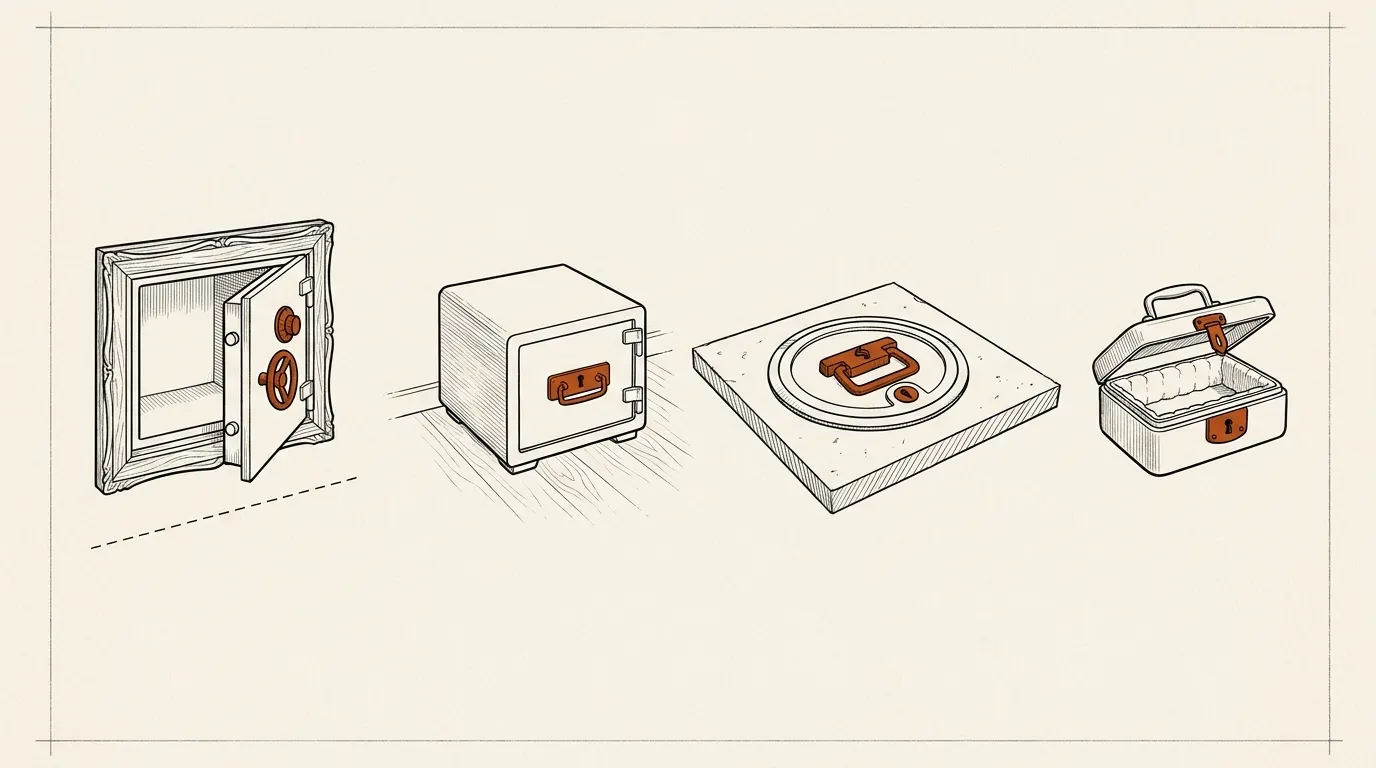
At the small end, a jewelry safe box is a compact lined safe for a dresser or closet shelf. At the large end, luxury jewelry safes are freestanding cabinets with many drawers, sometimes with a fire rating. In between are jewelry wall safes, closet safes with a drawer insert, and portable lined boxes.
Who a jewelry safe suits, and who should skip it
Burglary is still a household risk. The FBI estimates 661,800 burglaries in the US in 2025, with residential properties making up 53.4% of them. Jewelry is small, valuable and easy to carry, so it's an obvious target.
A jewelry safe suits you if:
- you own pieces you don't wear every day and want them out of a dresser drawer
- you want drawers that keep pieces separate and visible
- the safe can be bolted to a floor or installed in a wall
Skip it, or look at something else, if:
- you only need to lock away a few rings and a watch; a small home safe with a tray may be enough
- you mainly need fire protection for documents; see fire-rated home safes
- you can't anchor anything; a small unanchored safe is easy to carry out, whatever its interior
- the pieces are high value; ask your insurer what it expects before you buy
Jewelry safe ratings: what to look for
The interior is easy to judge from photos. The protection isn't. Read these specs in order.
Burglary rating. This is the one that matters most for jewelry. Two independent standards appear on home safes:
- UL 1037 Residential Security Container (RSC). A Level I RSC must resist a 5-minute attack by one person using common hand tools and a small electric drill, without the door opening or a 4-inch hand-hole being made.
- UL 687 burglary-resistant safes. It defines tool-resistant classes such as TL-15 and TL-30, which cover the door and front face, and higher classes that add torch resistance or test all six sides. These are a higher security class than an RSC.
Most jewelry safes carry neither. Without a rating, compare steel thickness, the door and the bolts instead. Our burglary safes page lists safes sold for burglary resistance, and the UL safe ratings guide explains the classes.
Steel thickness. A lower gauge number means thicker steel. Under the federal U.S. Standard Gauge, 10-gauge is 0.1406 in and 14-gauge is 0.0781 in. Some jewelry safes state plate thickness in inches instead. Either is better than "heavy-duty steel," which is not a measurement.
Fire rating. A fireproof jewelry safe should give a duration, a temperature and who tested it. UL 72 fire ratings have a class, the maximum interior temperature, and a time rating. Class 350 is intended for paper records. UL 72 is a standard for record protection, so its classes are written for paper and media, not jewelry. Decide what else will share the safe, such as documents or a drive, and pick the class for that.
The lock. Keypad, fingerprint, mechanical dial or key. A biometric safe for jewelry is fast. Our biometric safes page covers how fingerprint locks work and what to check about the backup. Every electronic lock needs a backup key or override, stored away from the safe. (Not in the jewelry box next to it. Picture Kevin, our hypothetical burglar: the jewelry box is the first thing he opens.)
Anchor holes. Pre-drilled holes and included hardware turn a carry-out into a bolt-down. Our floor bolting guide covers concrete and wood.
Wall, closet, floor and hidden jewelry safes
Jewelry wall safe. A wall safe for jewelry sits between studs. It's easy to hide behind a picture or mirror, but its depth is limited to the wall cavity, and its strength depends on how it's fastened to the framing. See our wall safes page.
Jewelry safes for closets. A freestanding safe with drawers, bolted to the closet floor. This is the most common arrangement. A closet is the first place many people look, so anchoring matters more than hiding. Our closet safes page covers sizes.
Floor safe for jewelry. Set into a concrete slab, a floor safe is very hard to remove. It's also hard to install and awkward to reach daily.
Hidden jewelry safe. A diversion container or a concealed compartment works only while nobody knows it exists. Our hidden safe ideas guide covers when hiding helps and when it doesn't.
Portable jewelry safe. A small lined lock box for travel. It keeps pieces organised and deters casual access, but it's built to be carried, by anyone.
How to store jewelry at home, safe or no safe
A safe is one part of storing jewelry at home. The routine around it does the rest.
- Split daily pieces from the rest. Keep what you wear every week in a dish or tray you use. Keep everything else locked.
- Keep pieces apart. Separate compartments stop chains tangling and harder stones scratching softer ones. That's what the drawers and ring rolls are for.
- Make an inventory. Photograph each piece, note any appraisal or receipt, and store the list somewhere other than the safe, such as cloud storage.
- Check your coverage. Ask your insurer how jewelry is covered and whether a specific safe or rating matters to them. Policies differ, and the answer is in yours, not on a safe listing.
- Anchor before you organise. Bolting the safe down comes first. Lining the drawers comes second.
- Limit who knows the code. Change the code from the factory default, and keep the backup key away from the safe.
If you keep documents in the same safe, the fire rating starts to matter more than the drawers.
How to read the jewelry safe table: steel and lock before drawers
The table lists safes with jewelry drawers or a lined interior. Values we couldn't confirm show as "—."
- Start with burglary rating and steel. If both are "—," the listing hasn't told you how well the safe resists attack.
- Check the fire columns. Duration, temperature and who tested it. A fire rating without a named tester is a manufacturer claim.
- Compare interior dimensions. Drawer height decides whether a watch box or a stacked bracelet fits.
- Check weight and anchoring. A light safe with no anchor kit is easy to carry off.
- Look at the lock and backup. Electronic locks need batteries and a backup key.
For the money, a plain home safe with good steel and a separate drawer insert can protect more than a lighter safe with a fancy interior. Small jewelry safes for home use trade capacity for easier concealment. A home jewelry safe with drawers suits a larger collection, but only if it's anchored.
Choose the steel first, then the drawers
Pick the protection by rating, steel and anchoring, then pick the interior that fits your pieces. Keep a photographed inventory somewhere else, and keep the backup key away from the safe.
Related pages
Questions people ask about jewelry safes
How should I store jewelry at home?
Keep pieces you rarely wear in a locked safe that is bolted down, with soft separate compartments so pieces don't scratch each other. Keep a written and photographed inventory stored somewhere else, such as cloud storage. Ask your insurer what coverage applies to jewelry and whether a particular safe rating is required.
What ratings should a jewelry safe have?
For burglary, look for an independent rating such as UL 1037 Residential Security Container or a UL 687 class such as TL-15 or TL-30. For fire, look for a UL 72 rating or a fire rating that states the duration, temperature and who tested it. Many jewelry safes carry neither, so check the listing.
Is a wall safe or a floor safe better for jewelry?
A wall safe is easy to conceal but limited by the stud depth and the wall material. A floor safe set in concrete is hard to remove but harder to install. A bolted-down freestanding safe is the simplest option for most homes.
Do jewelry safes have fire protection?
Some do and many don't. A jewelry safe without a stated fire rating should be treated as having no fire protection.
What is the difference between a jewelry safe and a jewelry box with a lock?
A locked jewelry box is usually wood or thin metal with a small lock that keeps honest people out. A jewelry safe is a steel safe with a jewelry interior. Check the steel, the lock and the anchor holes to see which one a listing actually is.
Sources
- UL 687 Burglary-Resistant Safes (UL Standards & Engagement) — accessed 2026-10-12
- UL 1037 Antitheft Alarms and Devices (UL Standards & Engagement) — accessed 2026-10-12
- Intertek requirement-change notice: UL 1037 revision 9-9-2016, Section 54 Residential Security Containers — accessed 2026-10-12
- Turning Up the Heat: A Sneak Peek into UL's Fire Testing of Safes (UL) — accessed 2026-10-12
- UL 72 Tests for Fire Resistance of Record Protection Equipment (UL Standards & Engagement) — accessed 2026-10-12
- Reported Crimes in the Nation, 2025 - Quick Stats (FBI UCR Program) — accessed 2026-10-12
- 15 U.S. Code sec. 206 - Standard gauge for sheet and plate iron and steel (Cornell LII) — accessed 2026-10-12